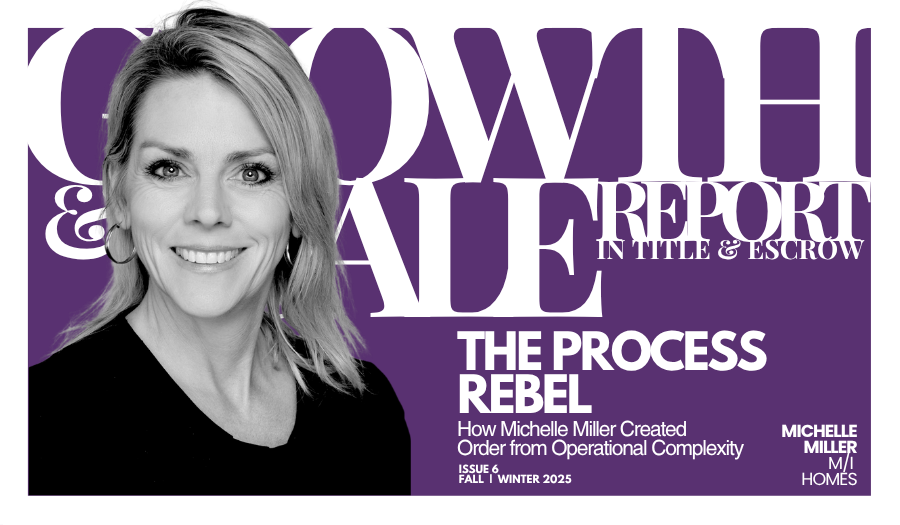
The Process Rebel
How Michelle Miller Created Order from Operational Complexity
Let’s get one thing straight: your software is not your process. That expensive system you bought to solve all your problems? It’s just a tool waiting for a plan. Most leaders never grasp this, throwing technology at chaos and hoping for a miracle. Michelle Miller has built a career on calling out this critical distinction: a system without a process is just an expensive way to multiply problems.
That wasn’t theory when she stepped into M/I Homes’ national title company. She didn’t inherit one business. She inherited sixteen. Sixteen strong local operations, each with their own well-established habits, their own “sacred way” of doing things. Common reporting was limited, making oversight difficult. “I was managing sixteen different operations instead of one company in sixteen locations,” she recalls.
For Miller, the challenge wasn’t a nightmare. It was the point.
Most people stumble into title; Miller architects it. With a criminology degree, an MBA earned mid-career, and a couple of years at mortgage tech firm Solidifi under her belt, she brought a project manager’s lens to an industry often drowning in its own details. Her guiding question became a mantra: What will create the biggest impact for the most people?
The Miller Doctrine
At the heart of her leadership is one clear belief: systems don’t fix chaos; processes do. “Your title production software will create your documents and track progress,” she explains. “But your process is what you do day to day. It’s how you move a file from start to finish.” Without that clarity, plugging a broken process into shiny new software just multiplies the mess.
At Solidifi, she’d seen how automation and middleware could transform businesses — but only if paired with clear, unified workflows. At M/I, those workflows existed, but were decentralized, so she set out to write a unifying process herself.
The Blueprint
Rolling out a new title production system across sixteen entrenched offices required more than change management. Miller calls it compromise management: acknowledging the discomfort of letting go of the old, while selling a vision of what the new can unlock. Her playbook boiled down to four decisive stages:
- Do the research. She hit the trenches, listening in every office, mapping frustrations, and learning the “why” behind each habit with the goal of unifying while keeping successful concepts.
- Marry process to system. With her AVPs, she created the holy grail: a single source of truth. Step-by-step process documents, tied directly into the software with screenshots and instructions — an operational playbook for the new way of operating.
- Build a safety net. She implemented a helpdesk and ticketing system so issues never disappeared into inboxes. Every ticket stayed open until it was fully resolved and tested, giving staff confidence and leadership a real-time diagnostic.
- Empower leaders. She leaned on her managers not to enforce change, but to champion it — empowering them, backing people up, and coaching them through friction.
The result wasn’t just a software rollout. It was a cultural reset. Sixteen companies began acting like one. One company with a scalable, future-proof structure.
The Project Manager in Chief
Ask Miller what she’d be doing if not in title, and she answers without hesitation: project management. “I identify issues. I prioritize them. I empower others to help solve them.” That’s how she sees her role today. It’s less an SVP with a static job description, more a project manager for the evolving enterprise — ensuring that M/I Homes’ title operations continue scaling sustainably.
Her entire career has been one long project arc: from learning every role in a title office, to earning her MBA “to prove a point” to her siblings, to absorbing the high-tech lessons of the mortgage world, to orchestrating national-scale operational change.
She doesn’t flinch at obstacles. She breaks them down, analyzes the data, writes the process, and moves forward. Step by step. Process by process. “You look back two years, and oh my goodness, look at the change we’ve made,” she reflects. “Day-to-day, it doesn’t look so striking.” For Michelle Miller, that’s the point. Loud revolutions rarely last. The ones that do are built the same way she built her career: process by process, not system by system.