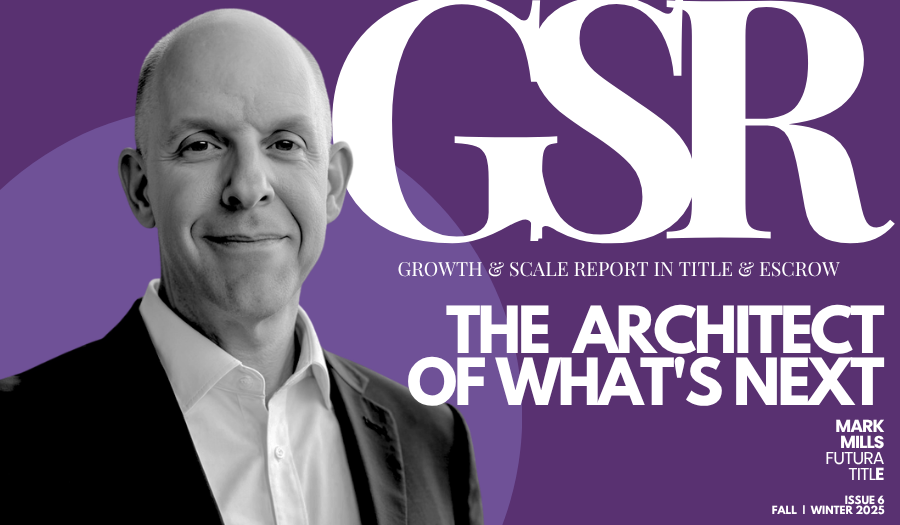
The Architect of What's Next
Mark Mills never set out to be a title guy. On his first day at Futura Title, the accountant by trade stared at the balance sheet and had to ask his boss a humbling question: “What the hell is a title plant?” It was the company’s largest asset, and he had no idea what it even was.
That candor wasn’t weakness; it was the start of a leadership style rooted in honesty, curiosity, and a refusal to pretend. Mills came from the massive corporate halls of Albertson’s, where he was one accountant among 250,000 employees, a cog in a wheel too big to move on his own. Leaving that world wasn’t just about finding a new job; it was about finding significance. “I wanted to go to a smaller business where I could have a larger impact,” he recalls. At Futura, he discovered the blueprint he’d been searching for: a place where numbers mattered, but people mattered more.
That perspective shaped the central question of his career: How do you keep the small-company feel in a big company? Mills found his answer in relationships; not just as a slogan, but as the architecture for everything Futura Title would become under his watch.
When he became CEO in 2023, he followed a leader who had held the role for 24 years. Larry Matney was revered, his legacy woven into the company. Mills respected it so deeply that he refused to move into his predecessor’s office. “I couldn’t envision myself sitting in Larry’s office,” he says. “I’m not Larry, and I’m not going to try to be him.” Instead, he turned the office into a conference room, a symbol of continuity, respect, and a new chapter written in his own way.
Since stepping into the CEO role, Mills has been reshaping Futura without flash or fanfare. He’s consolidated technology, restructured operations, and led acquisitions both in the Pacific Northwest and across the country. But ask anyone at Futura, and they’ll tell you his real impact isn’t in the transactions. It’s in the way he’s made a 650-person enterprise feel both big and small at once.
That balance comes from the framework he’s building. Mills doesn’t describe himself as a visionary or a disrupter; instead, he talks about architecture. For him, leadership is about designing structures that last, structures that let people thrive, hold the weight of growth, and stand steady through change. In practice, that architecture rests on four principles: empower the experts, set a cadence for culture, insist on accountability, and prepare the next generation.
1. Let the Experts Be the Experts
Mills knows what it feels like to be a cog in the wheel, and he’s determined never to let others feel that way. His first principle is empowerment. Every time Futura acquires a new company, he makes the same promise: “Let us take the back-office work off your plate so you can focus on your customers.”
HR, IT, and accounting are the functions that belong at the center. But the heart of the business is local expertise, and Mills refuses to meddle with that. He believes the best leaders are architects, designing the framework that allows their craftspeople to shine. By empowering local managers to be the face of their markets, he ensures that Futura grows without losing its personal touch.
- Culture Runs on Cadence
Growth can easily overwhelm culture. Mills saw that after a whirlwind of acquisitions and system upgrades, people felt stretched thin and disconnected. His answer wasn’t a grand speech but a rhythm: weekly leadership meetings, monthly division check-ins, a predictable cadence that keeps communication flowing.
“How people feel connected to the company can be very different,” he says. But by creating a steady rhythm, Mills is building trust, connection, and consistency.For him, cadence is culture: it’s how a big company keeps its small-company feel.
3. Accountability as the Foundation
The accountant in Mills hasn’t gone away. He still believes numbers tell the truth. “Results are the one thing you can’t fake,” he says. In an industry built on relationships, accountability can sometimes feel like the tough part, but Mills frames it differently: it’s not punitive, it’s structural.
Accountability is what allows freedom. By making performance measurable and reliable, Mills creates the confidence to take risks, to innovate, and to grow. It’s the foundation that ensures every brick in the structure holds.
4. Building the Next Generation
Mills’s last principle may be his most personal. He knows the leaders of today won’t be the leaders the industry needs tomorrow. So he will be investing heavily in training and leadership development. “The leaders that are going to be successful 20 years from now are going to have a different skill set,” he says. He’s not just running a company; he’s building its future.
That means looking for the next generation of architects and giving them the tools, training, and opportunities to design what comes next. He isn’t just drafting Futura Title’s blueprint for today. He’s drafting it for decades to come.
Mark Mills may never have searched a title or closed a deal, but in many ways that’s the point. He came into the industry as an outsider, looked at the business like a blueprint, and set about strengthening its foundation. His legacy won’t be defined by loud pronouncements or dramatic gestures. It will be built quietly, piece by piece, in empowered local leaders, a steady cadence of communication, accountability that everyone can trust, and a new generation ready to carry the work forward.
Mills calls himself an accountant by training, but to Futura Title he has become something more: the architect of what’s next.

.png?length=350&name=Don%20Kennedy%20~%20CloseSimple%20Growth%20and%20Scale%20Report%20Fall%202024%20(2).png)